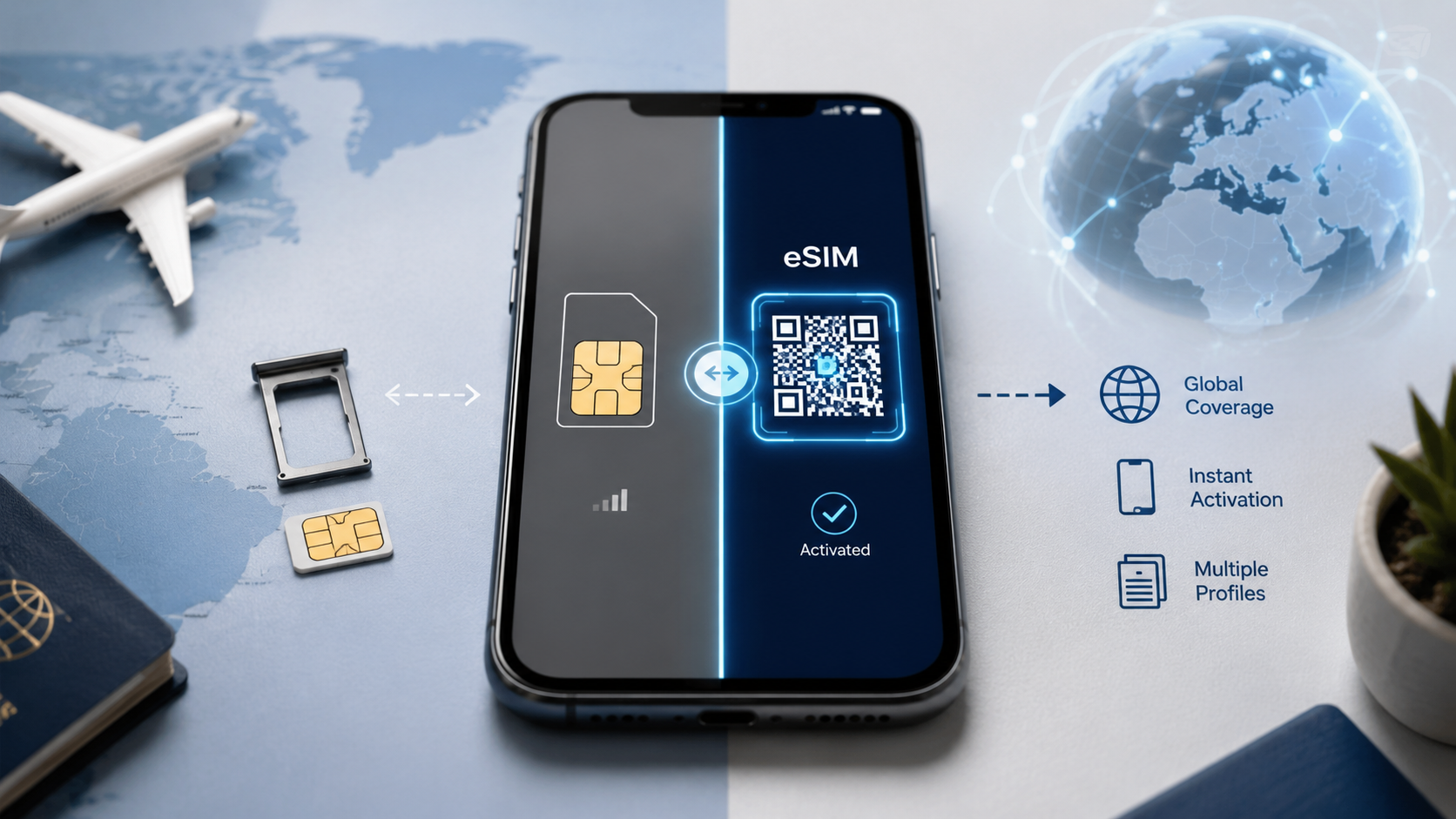
More than 2 billion devices currently support eSIM technology, yet physical SIM cards still ship in the majority of smartphones sold worldwide. The two formats coexist in most modern devices, and for good reason: each has genuine advantages depending on how you use your phone. This guide cuts through the noise and gives you a practical framework for deciding which option makes sense for your situation.
Understanding the Basics
A physical SIM is a removable plastic chip that stores your carrier credentials and authenticates your device on a network. You insert it into your phone, and it identifies you to your carrier. Swapping carriers means swapping cards.
An eSIM is a digital version of the same thing, embedded permanently in your device’s hardware. Instead of inserting a chip, you download a carrier profile by scanning a QR code or entering an activation code. The profile installs in minutes and works identically to a physical SIM once active. Most modern devices support storing multiple eSIM profiles simultaneously and running two lines at once in Dual SIM mode.
Device Compatibility in 2025
eSIM is now standard on all flagship and most mid-range smartphones. On the Apple side, every iPhone from the XS onward supports eSIM. The iPhone 14 and later in the US market removed the physical SIM slot entirely, making eSIM the only option. In other markets, current iPhones maintain a physical SIM slot alongside eSIM support.
On Android, Samsung Galaxy supports eSIM from the S20 series onward. Google Pixel supports it from the Pixel 3. Motorola Edge and Razr lines, OnePlus flagships, and most current Sony Xperia models also support eSIM. Budget Android devices are more variable: check the specifications page of your specific model before assuming compatibility.
One prerequisite that catches many users off guard: your device must be carrier-unlocked to use a third-party eSIM. Phones purchased on carrier contracts in the US are often locked for a period. AT&T, Verizon, and T-Mobile all unlock devices on request once eligibility requirements are met, typically after the contract term ends.
The Core Trade-offs
Setup speed and convenience is where eSIM wins decisively. Activating an eSIM takes three to five minutes from any location with internet access. Getting a new physical SIM requires either a store visit, waiting for mail delivery, or purchasing a local card on arrival at a destination, each of which introduces friction.
Flexibility for travel is the clearest practical advantage of eSIM. Traveling internationally with a physical SIM means either paying roaming fees to your US carrier or sourcing a local SIM at each destination. An eSIM profile for a specific country or region activates before you leave home. You land connected, with your US number still active on your physical SIM simultaneously.
Profile management is more sophisticated on eSIM. Modern iPhones store up to eight eSIM profiles and can switch between them without deleting and re-downloading. This means frequent travelers can maintain profiles for multiple countries and activate the relevant one before each departure. Physical SIM management is simpler in concept but requires physical handling.
Device security is marginally stronger with eSIM in one specific scenario. A physical SIM removed from a stolen phone can be used in another device. An eSIM is cryptographically bound to the hardware and cannot be extracted. SIM swapping attacks, where a fraudster convinces your carrier to transfer your number to a new SIM, are significantly harder to execute against an eSIM because there is no physical card to claim.
Physical SIM still has practical advantages in specific contexts. For long stays in a single country, a local prepaid SIM often offers better rates than any travel eSIM plan. In regions where eSIM adoption is low, local SIM infrastructure may be more developed and affordable. And for users on older devices without eSIM support, the physical format remains the only option.
International Travel: Where eSIM Pulls Ahead
The international travel use case is where the eSIM advantage is most concrete and quantifiable. US carrier international roaming plans typically charge $10 to $25 per day. On a two-week trip, that adds $140 to $350 to your monthly bill before a single call is made.
A travel eSIM from a dedicated provider covers the same period for a fraction of that cost, with performance that often matches or exceeds roaming because the connection runs directly on local networks rather than through your US carrier’s roaming partnership. International phone plans with Holafly cover over 200 destinations with unlimited data options, activated via QR code before departure so you have a working connection the moment you clear customs.
For travelers who visit multiple countries on a single trip, the advantage compounds. Instead of sourcing a new local SIM at each border, you switch eSIM profiles from your phone’s settings. The entire process takes under thirty seconds.
Dual SIM: Getting the Best of Both
The most practical configuration for frequent travelers is running both simultaneously. Your physical SIM handles your US number, incoming calls, and SMS. Your travel eSIM handles data. Both are active, and you switch data sources from settings without removing anything from your phone.
This setup means you never miss calls or texts to your US number while traveling internationally. It also means you are not paying roaming rates for data just to keep your number accessible. The physical SIM sits dormant on your US carrier’s network for calls and texts while the eSIM provides data at local rates.
On iPhone, this is configured under Settings, Cellular, where you assign each line a default role. On Android, the SIM Manager or equivalent settings menu handles the same configuration with similar simplicity.
When to Choose Physical SIM
Physical SIM makes more sense when your device does not support eSIM, when you are on a long-term stay in a single country where a local SIM offers significantly better monthly rates, or when you are purchasing service from a carrier that has not yet implemented eSIM support. Smaller regional carriers and prepaid providers in some markets have been slower to adopt the technology, making physical SIM the only option for their plans.
It also remains the simpler choice for users who do not travel internationally and have no need to manage multiple carrier profiles. If you buy a phone, insert your carrier’s SIM, and never need to change it, the advantages of eSIM are largely theoretical for your use case.
eSIM vs Physical SIM FAQs
Can I have both a physical SIM and an eSIM active at the same time? Yes, on most modern smartphones. This is Dual SIM mode. You assign different functions to each line. The most common setup for travelers is physical SIM for calls and texts, eSIM for data.
What happens to my eSIM if I get a new phone? eSIM profiles are tied to the device hardware. When you upgrade, you need to transfer or reactivate your profiles. Most major carriers support eSIM transfers between devices. Third-party travel eSIM providers handle this differently: check your provider’s policy before trading in your phone.
Is eSIM available on budget Android phones? Increasingly, but not universally. Mid-range devices from major manufacturers are adding eSIM support in recent generations. Budget devices under $300 are less consistent. Always verify before purchasing a travel eSIM plan if you are unsure about your device.
Can I switch back to physical SIM after using eSIM? Yes. Switching between your physical SIM and eSIM is handled entirely in software settings. Deactivating an eSIM profile does not delete it, and reactivating takes seconds.
Does eSIM use more battery than physical SIM? No measurable difference has been documented in real-world testing. Both SIM formats consume negligible power during standby. The difference, if any, is below the threshold of practical significance.